Big Top
Character Study: Simple Calder
Simple Calder, the lighthouse keeper from the Calder stress test redrawn in a simpler cartoon style, taken from one paragraph to a textured, rigged character walking on a library walk cycle, with each rough edge shown and what it takes a person to fix it.

Simple Calder is the same character as Calder, our stress test, drawn in a simpler style: the same lighthouse keeper in the same long yellow oilskin coat, cap, scarf and boots, but with rounded shapes, slightly exaggerated proportions and flat, clean color. Calder is the hardest, most detailed case we put through the chain. Simple Calder sits beside him to show what changes when the costume stays and the detail goes, and he sits beside Tommy, the other simple character.
As on the other character pages, each step is a job in the suite that wrote an asset with its parents recorded, and each flaw comes with what fixes it today and our estimate of an experienced artist's time.
1. A concept from a sentence
Simple Calder began as a paragraph: a tall, lean lighthouse keeper in his fifties, in a polished animated-feature style with simple rounded shapes, a long bright yellow oilskin raincoat buttoned to the chest, a thick grey knit fisherman's cap, dark trousers tucked into tall black rubber boots, a navy scarf and a short grey beard. Concept painted him on the show's rainy night-market street.

2. Lifted out, and stood in an A-pose
The isolation step cuts him out and redraws him on a clean ground. Its settings asked for exactly two arms, each held out and down from the body with open hands, and nothing hanging at his sides.
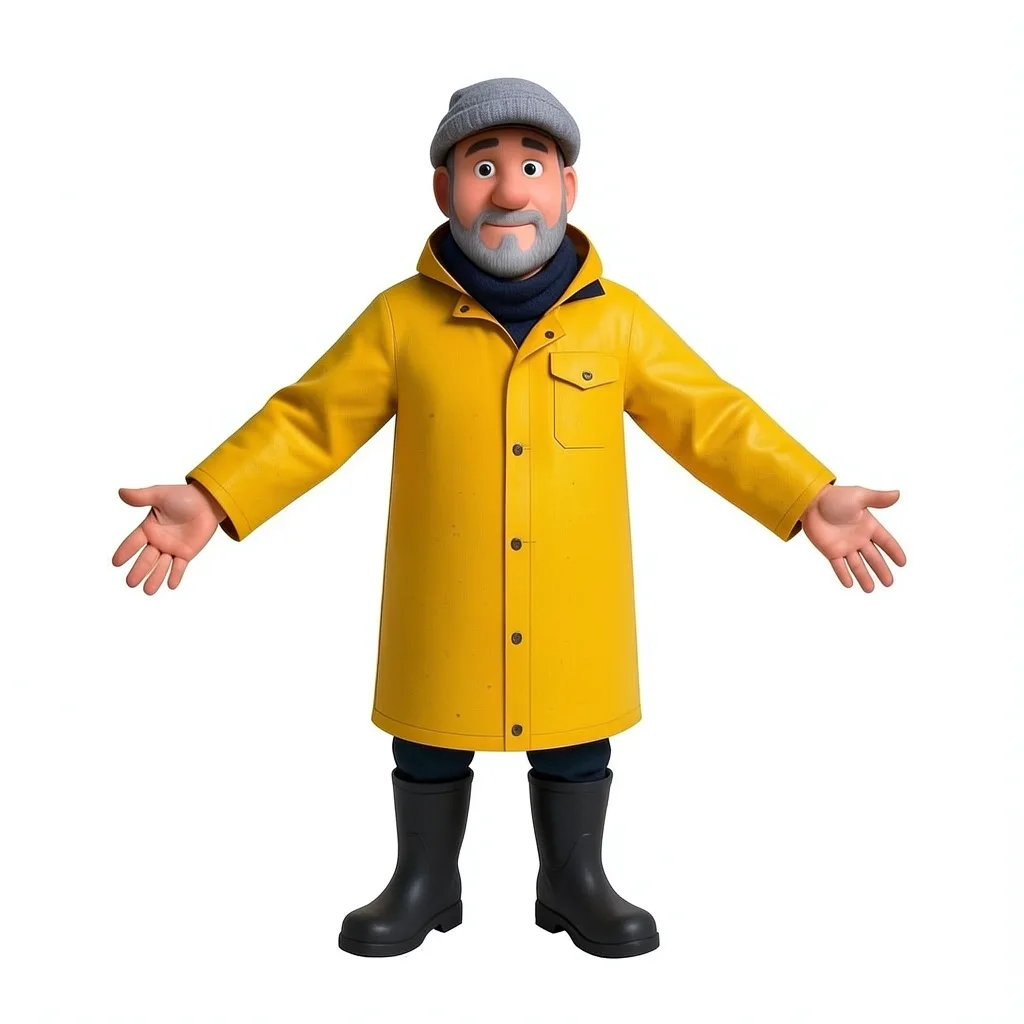
3. A turnaround, on the third seed
The turnaround imagines him from six sides, and those views are what the mesh is built from. The first two attempts each invented something that was not in the concept: one added a patch to his coat, the other an emblem. The third was clean.

The fix: re-run the step with a new seed until the views match the concept. Estimated artist time: about a minute.
4. A mesh
The mesh step builds a 3D surface from the views: cap, beard, the coat with its hood, pocket and buttons, and the boots.
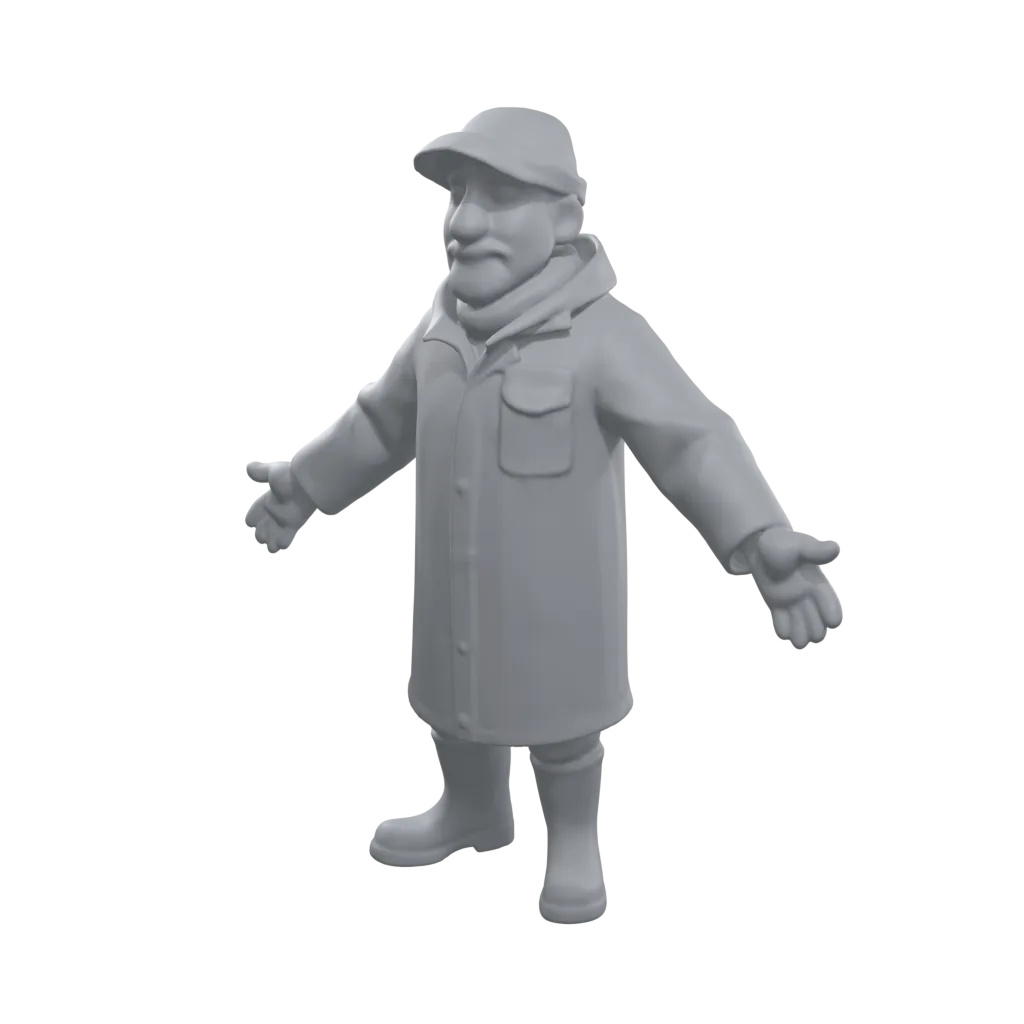
5. Texture, with the views lined up
The texture is painted from the turnaround's views, and those views are generated separately, so they never agree exactly. On Simple Calder the disagreement broke his face up: grey patches from the cap and beard landed across his cheeks and around his eyes.
The suite now lines the views up before painting, the fix first made for Tommy. The front view is the anchor, and each other view is warped to agree with it wherever both see the same surface. Near the edge of the front view's zone, the other views' colors fade into the front view's, so the hand-over is a ramp rather than a hard cut. His face comes out clean.


A few marks remain: smudges at the collar and on the hands, a faint seam down one cheek, and a thin dark line at each temple, where the hair under his cap lands slightly off the mesh. Nothing in the suite fixes these yet.
The fix: paint over them in a 3D paint program. Estimated artist time: 10 to 15 minutes.
6. A rig, and elbows that looked dislocated
A standard humanoid skeleton is fitted to him by measuring the mesh, the same way as on Calder and Tommy, and the rigging model binds his surface to it. On him, the fit cannot find two points by itself. It looks for the neck at the narrowest slice of the body, and on Simple Calder that slice lands inside the cap, because his cartoon head is wider than the neck hidden under his hood. And against his big, mitten-like hands, the cuff gives no reliable shape to find the wrist by.
The fix: a person sets the neck height and the wrist position in the fit's settings, and the fit places the joints from them. Estimated artist time: about 2 minutes.
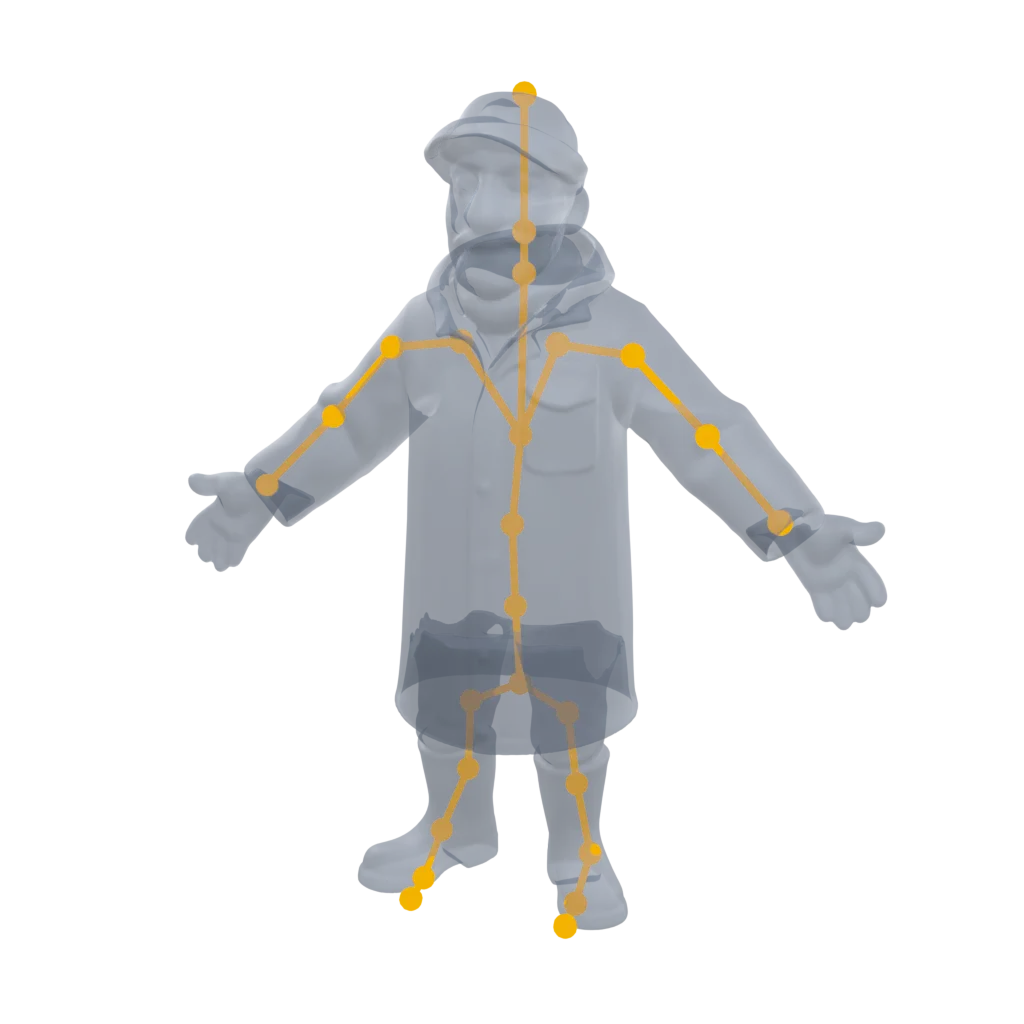
When he walked, his elbows looked dislocated: each sleeve kinked partway down the forearm with a hard step. There were two causes, and both are now fixed in the suite. The joint fit had put each elbow two thirds of the way down the forearm; it now always puts the elbow halfway between the shoulder and the wrist, and no one sets it by hand. And when a walk was moved onto his skeleton, the forearm took half of the hand's twist, which wrung the coat sleeve at the elbow; the hand now takes all of it.
7. Walking
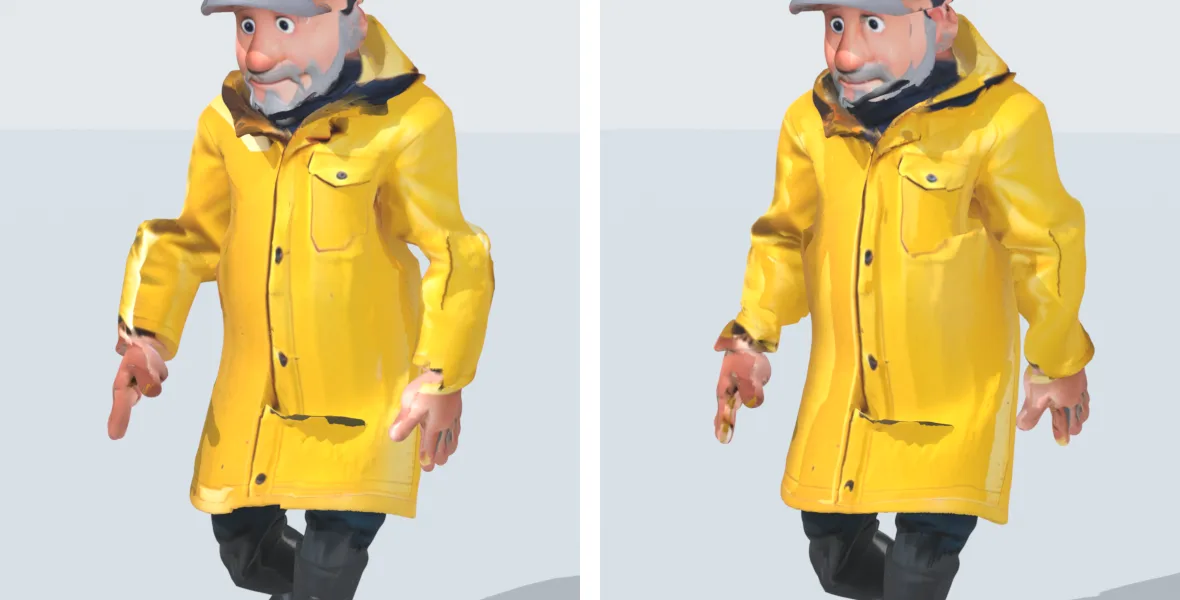
The motion model generates a walk from a line of text, and it plays on his own rig. As with Tommy, the flaw is in the skin: the coat creases around his shoulders as his arms swing, because the skin weights there are shared between the arm bones and the chest.

The fix: smooth the skin weights around the shoulders with a weight-painting brush, in Big Top's Rigging app or in Blender on a round trip. Estimated artist time: 15 to 30 minutes.
The video at the top of the gallery is the same rig walking a cycle from the curated motion library, with the lined-up texture. For this walk, Big Top's arm-clearance suggestion kept his arms straight down at his sides and swung them 15 degrees back.
Walk motion from the 100STYLE dataset (Mason, Starke and Komura), CC BY 4.0.
What it took
Out of seven steps, three needed nothing from a person beyond starting them and looking at the result. Two of his worst flaws, the broken-up face and the dislocated elbows, were fixed in the suite itself, so no character needs those touch-ups again. The rest is a minute to re-seed the turnaround, 10 to 15 minutes of paint, about 2 minutes of joint placement and 15 to 30 minutes of weight smoothing: 28 to 48 minutes of artist time, all of it editing what the suite made rather than starting again.
Gallery
Simple Calder walking on his fitted rig, with a walk cycle from the motion library, textured. Walk motion from the 100STYLE dataset (Mason, Starke and Komura), CC BY 4.0. Simple Calder's concept, painted in the show's night-market style.
Related work
-

BigBluePipeline
A VFX studio pipeline, rebuilt as the artist-side front end for Big Top.
-
Depth2STL and Obj2GLB
Two small open-source tools for getting 3D data where it needs to go.
-

QIE Studio
An image generation and editing studio, built by an AI agent working unattended from our specification.
-
AuRA Avatar Generator
Customizable, photorealistic presenters for AI-generated video briefings.