b2c3d
Rigging
Rigging gives a generated mesh a skeleton and skin weights, then is built around reading and correcting what the rig model decided.

A generated character is a statue until something tells its surface how to bend. Rigging gives a mesh a skeleton and per-vertex skin weights, then gets out of the way so a person can fix what the model decided.
Reading the proposal
The model cannot know that this elbow has to bend past ninety degrees for the shot, or that a fox's shoulder sits lower than a person's. So the application is built around reading its proposal rather than accepting it.
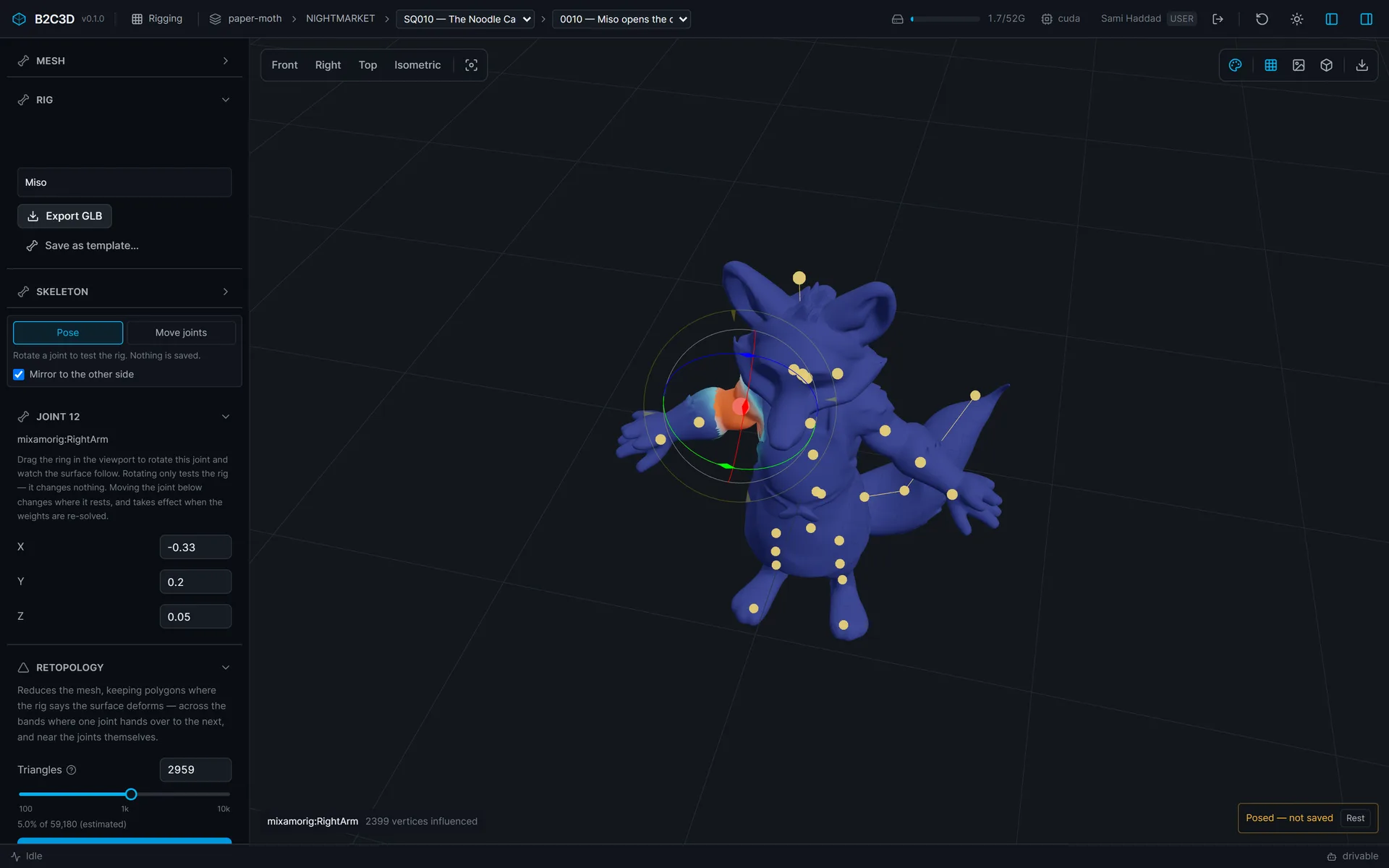
Every joint is listed as a hierarchy with the number of vertices it actually moves, so a joint that moves nothing shows as a dash instead of hiding. Selecting a joint turns the surface into a heat map of its reach, cold where it has no influence and hot where it has all of it. The check on Miso's left arm is that the heat stops at the shoulder and does not bleed into his apron.
A weight map says where a joint reaches, not what the surface does when it gets there. Pose mode answers that: a rotation ring on the joint moves the surface with the rig's own weights, and nothing is saved. A notice says the rig is posed and not saved, and Rest puts it back. Raising Miso's right arm shows the shoulder pinching, which says the joint sits too high.
Correcting it
When a joint is in the wrong place, Move joints changes where it rests rather than rotating it. With mirroring on, moving the right arm moves the left with it. The panel counts the moved joints and warns that the weights still belong to where the joints were, until they are solved again for the corrected skeleton. The correction is a new rig that descends from the one it corrected, and that one stays in the library.
Whose skeleton
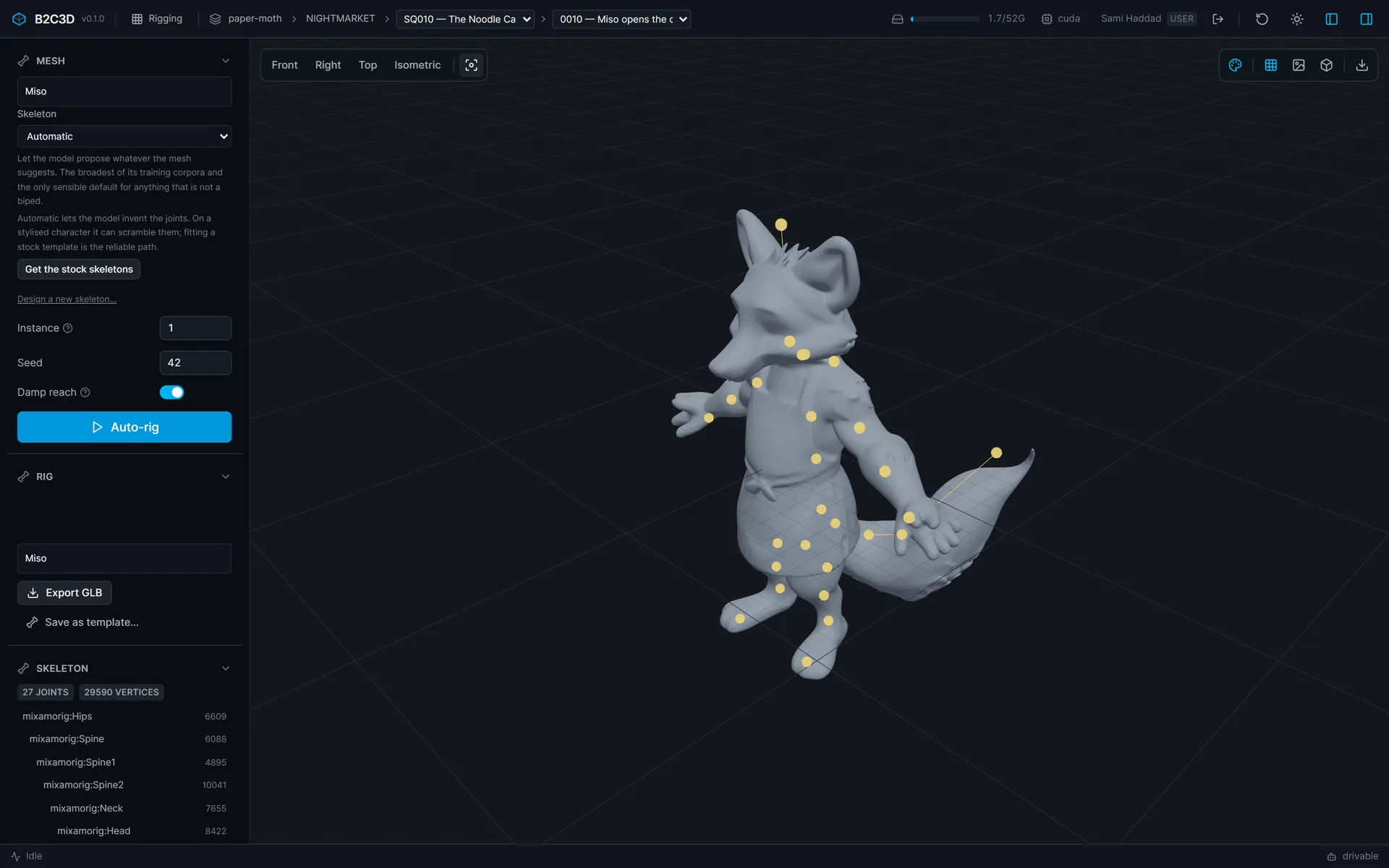
A production does not want every character to have its own invented skeleton. Rigging offers a choice: let the model propose one, ask for a human layout named the way Mixamo or VRoid name joints, or fit a skeleton template the production has authored.
Templates are drawn in a small symmetric editor. Positions are normalized, so a template is proportions rather than a fit to one character. A centre joint stays on the mirror plane; a joint added off it is created with its partner, and the two stay linked through every later move. Renaming one renames the pair, each side spelled by the template's rule.

Fitting a template places its joints inside a new mesh and solves only the skin. Miso, fitted to the show's Night Market Biped, carries the template's joint names, so Animate can read his hips and chest as a humanoid. A rig that came out well can be saved as a template in turn, so every character on a show can share one layout.
From dense mesh to real time
Rigging also owns the step from a dense generated mesh to something a real-time scene can afford. Its retopology reduces the mesh towards an exact triangle budget while keeping polygons where the rig says the surface deforms: across the bands where one joint hands over to the next, and near the joints themselves. Every attempt starts from the full-resolution mesh and stays a draft until somebody publishes it, so trying five budgets leaves one level of detail in the library rather than five, bound to the same skeleton.
Where the rig goes
The rig is data, linked by provenance to the mesh it was made from and, through it, to the concept image that started the character, so opening a rig brings its mesh and its reference image back with it. Animate puts motion on it, Studio plays that motion in a scene, Assets carries it through review and approval, and export_rig writes it as a skinned GLB for Blender, Maya or Max, keeping the strongest four influences per vertex. The export is added to the rig asset as a second file rather than stored as a new asset, so the library keeps one entry and one provenance chain.
Our rig model's training corpus is unreleased, so the model is interim under our provenance policy, and the Skeleton panel says so on every rig it makes. Every operation behind the application is also an agent tool, so an agent can rig, fit, reduce and export a character in the same terms a person does.
Gallery

Miso's first rig, with Mixamo-style joint names. 
Miso rigged, tail and all.
Related work
-

BigBluePipeline
A VFX studio pipeline, rebuilt as the artist-side front end for b2c3d.
-
Depth2STL and Obj2GLB
Two small open-source tools for getting 3D data where it needs to go.
-

QIE Studio
An image generation and editing studio, built by an AI agent working unattended from our specification.
-

AuRA Avatar Generator
Customizable, photorealistic presenters for AI-generated video briefings.