xR Ecosystem
A modular, device-agnostic programming interface for mixed reality.
 Eddie OffermannArchitect
- Role
- Architect
- Areas
- XR, Research, Tools
Building HoloFlect meant working backwards from a finished device to the technology it depends on. After exploring a lot of personal, everyday uses for AR, the conclusion was that AR on its own remains hard to justify. The best applications are around connected devices, home hubs and instrumented spaces, and distributed compute has real potential.

What's missing
- Depth sensing is limited. Commercial sensors are designed for a room or less, unifying several of them is difficult at best, and the best designs are built for something else, like robotics or autonomous vehicles.
- Few devices talk to anything else. Almost every networked device is an island with its own ecosystem, and every sensor has its own incompatible API.
- AR development platforms are narrow. They're built around simple visualizations and games, for specific devices.

A modular, abstract interface for xR
The response is a programming interface built on modular design and device abstraction:
- A nodal interface that simplifies development.
- Sensor data standardized into unified data types, whichever device produced it.
- Distributed compute as a core part of the design rather than an afterthought.

Where it started
Before the enterprise headset, there was a simple, inexpensive AR headset: a phone-based prototype built from a Samsung Galaxy S6 and a Leap Motion controller.
Related work
-
AquariOS
One platform for AR and VR apps, running several at once, on whatever headset or phone you have.
-
Cardforia and SecureVR
Unity building blocks for phone-based AR and VR.
-

Enhanced Presence
A run of prototypes chasing the feeling of being in the room with someone far away.
-
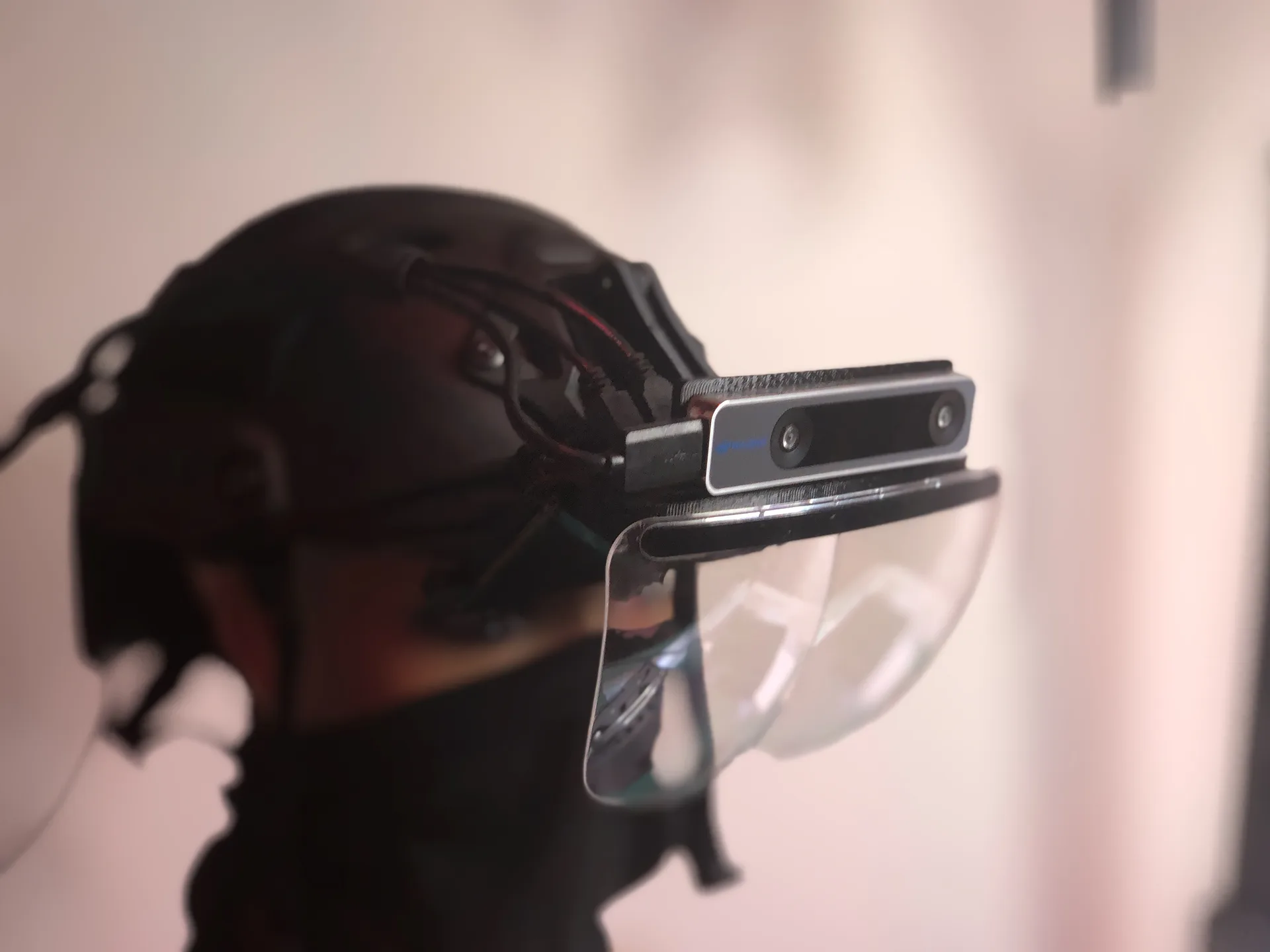
HoloFlect
A modular, upgradeable AR headset platform built for enterprise.