PiperTTS for Unity
On-device neural text-to-speech for Unity on Windows, macOS and iOS.
 Eddie OffermannArchitecture and engineering
- Role
- Architecture and engineering
- Areas
- AI, Tools, Research
Cloud text-to-speech sounds good but adds a network round-trip to every sentence and stops working without a connection. With PiperTTS for Unity we put a neural voice inside the app instead, so synthesis runs entirely on the user's device.
Architecture
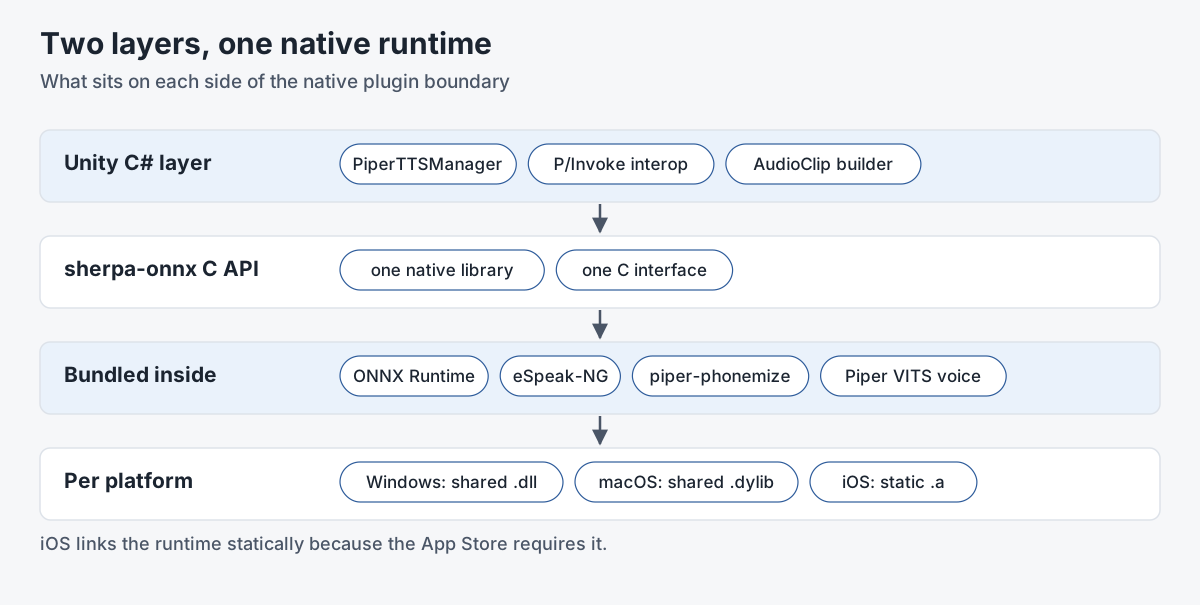
The voices are Piper models: VITS networks exported to ONNX, compact enough to ship in an app. Rather than wire ONNX Runtime, a phonemizer and the model together separately on every platform, we use sherpa-onnx as a single C/C++ runtime that bundles ONNX Runtime, eSpeak-NG and piper-phonemize behind one C API. Unity talks to it through a thin P/Invoke layer.
- Windows and macOS load sherpa-onnx as a shared library.
- iOS links it statically, as the App Store requires.
Data flow
- Text goes through a preprocessing step that strips expressions and emotes not meant to be spoken.
- The manager component dispatches synthesis to a background thread, so the main thread never blocks.
- sherpa-onnx phonemizes the text with eSpeak-NG and runs the VITS model.
- The PCM samples come back to the main thread as a Unity
AudioClipand play through a normalAudioSource.
Practical details
Adding a voice means dropping its folder into the project. Piper models published on Hugging Face lack the metadata sherpa-onnx expects, so the repo includes tools that generate the phoneme token map and inject that metadata. eSpeak-NG's compiled phoneme tables and dictionaries aren't produced by the sherpa-onnx build, and the docs cover where to get them. We also tracked licensing: eSpeak-NG is GPL-3.0, which matters when linking statically on iOS.
We built PiperTTS as part of our on-device voice research for Frndo, whose app uses a different, server-side voice. Its engine code is reused in OpenVoice for Unity.
Sources
Related work
-
OpenVoice for Unity
Cloned, emotionally varied voices synthesized on the device, in Unity.
-
Whisper.Sentis
Whisper speech-to-text running inside Unity on the Sentis inference engine.
-

Aesopic
AI-assisted long-form fiction, structured from series concept down to the page.
-
AquariOS
One platform for AR and VR apps, running several at once, on whatever headset or phone you have.