Realtime Mocap Camera for Games
A camera operator on a mocap stage, shooting footage inside a live game.
 Eddie OffermannEngineer
- Role
- Engineer
- Areas
- VFX, Tools, Pipelines
For a major game publisher I built a realtime motion-capture bridge between a Vicon stage and a flagship shooter's engine. It streams a virtual camera position into the unmodified game, so a human camera operator on the stage can shoot combat footage as if embedded with a group of soldiers, for marketing and esports. The approach extends readily to other titles.
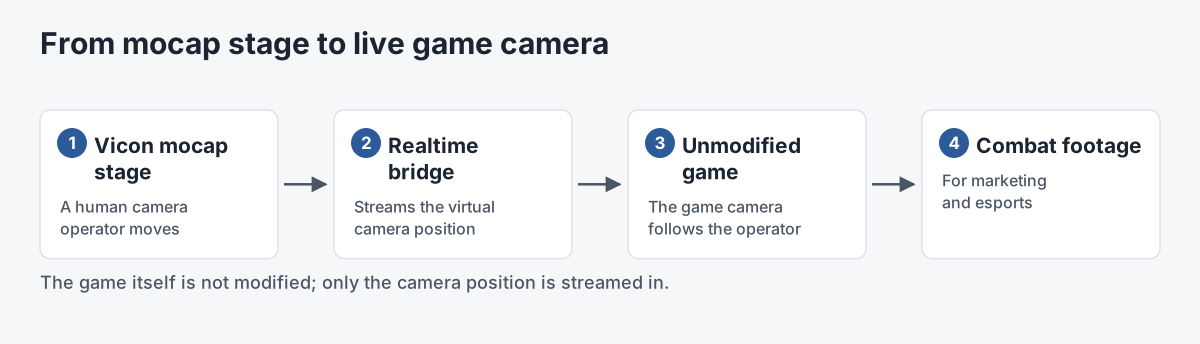
That's a different thing from traditional machinima, where the observer camera is just another character, piloted the usual way. Here the camera moves the way a person holding it moves.

A second engine
I built a similar realtime mocap solution for a second game engine, with a Lua plugin inside the game that receives camera pose, field of view and other data, for the same kinds of shoots.

Related work
-
b2c3d
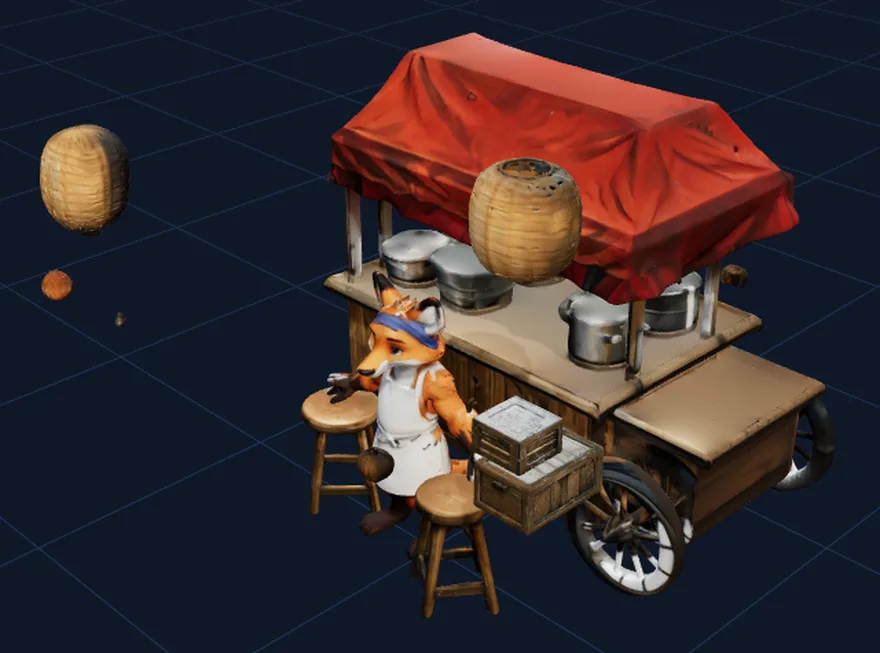
Traditional 3D content creation, rebuilt with AI inside the tools.
-

BigBluePipeline
A VFX studio pipeline, rebuilt as the artist-side front end for b2c3d.
-

Animated Lobby Installation
A large, continuously animated, immersive lobby.
-

AuRA Avatar Generator
Customizable, photorealistic presenters for AI-generated video briefings.