iOS LiDAR Scanner
3D scanning and surface reconstruction on LiDAR-equipped iPhones and iPads.
 Eddie OffermannDeveloper
- Role
- Developer
- Areas
- XR, Computer Vision, Apps, VFX

Recent iPhones and iPads carry a LiDAR sensor next to the RGB camera. We built a Unity framework on AR Foundation and ARKit that turns that sensor into a 3D scanner, for object scanning, AR visualization and 3D asset creation.
The pipeline
- Scanning. Point clouds are captured in real time, and each 3D point is projected into the camera image to pick up its color. There are two modes: freeform, with the device held in the hand, and turntable, with the device fixed and the object rotating, captured a step at a time.
- Processing. Modular filters clean the cloud: voxel-grid downsampling, statistical outlier removal, radius outlier filtering and bounding-box clipping, with a one-level undo.
- Spatial structure. The cleaned cloud goes into a generic adaptive octree, used for spatial queries, level of detail and meshing. An editor gizmo draws the octree's leaves for debugging.
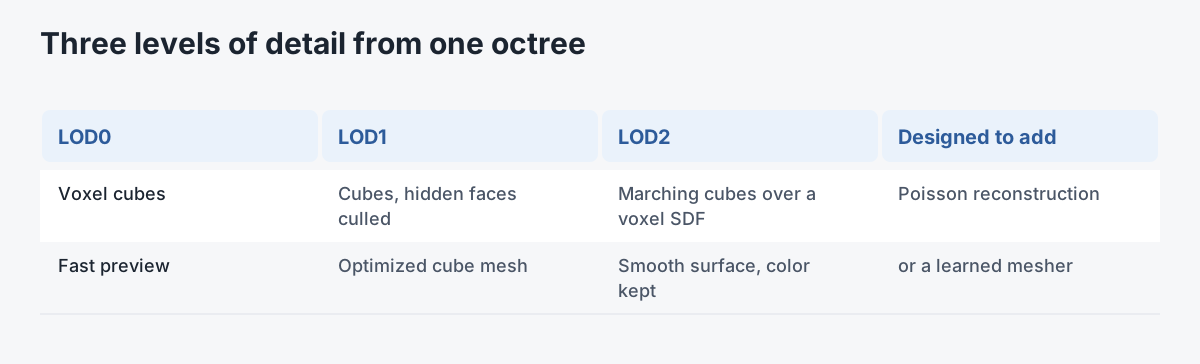
- Reconstruction. Meshes come at three levels of detail:
- LOD0: a fast voxel-cube preview.
- LOD1: an optimized cube mesh with hidden faces culled.
- LOD2: a smooth surface from marching cubes over a voxel signed distance field, with color carried through.
- Visualization. The scan and the live mesh preview are overlaid on the camera feed.

Design
Each stage is its own component with a small public API: capture, processing, octree building and meshing can each be swapped or extended independently. Mesh generation runs asynchronously and raises an event when a result is ready, so the interface stays responsive while it works. The reconstruction architecture is designed to take Poisson reconstruction or a learned mesher as another level of detail.
Scanning real objects into usable meshes connects to our capture work in CameraSmartPlate and to the asset side of b2c3d.
Gallery
Concept illustration of the scanning experience. 
The scanning and reconstruction framework, as a class diagram.
Related work
-

AR Scuba
An underwater 360 video performed as a hologram.
-

Augmented Clothing
Clothing as a platform for augmented reality, starting with hats.
-
Cardforia and SecureVR
Unity building blocks for phone-based AR and VR.
-

MagicWatch
Augmented reality that turns context cues into live database views.